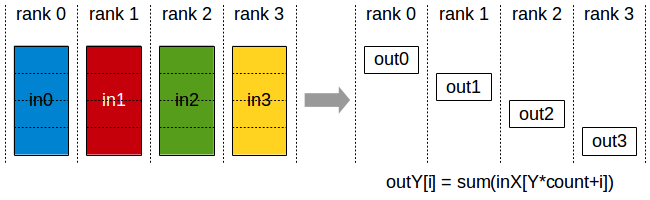
接下来简单介绍几种 NCCL (NVIDIA Collective Communications Library) 的通信方式,不涉及原理,只是简单展示下效果。
scatter
gather
broadcast
reduce
all reduce
all gather
reduce scatter
1
2
3
4
from IPython.display import Imageimport loggingimport torchimport torch.distributed as dist
pytorch 分布式相关api
torch.distributed.init_process_group() ,初始化进程组,必须先用这条命令才能使用 torch.distrubuted 相关操作。torch.distributed.get_rank(),可以获得当前进程的 rank;torch.distributed.get_world_size(),可以获得进程组的进程数量。torch.distributed.barrier(),同步进程组内的所有进程,阻塞所有进程直到所有进程都执行到操作。
节点获取信息 1 2 3 4 5 6 7 8 def main (): dist.init_process_group("nccl" ) rank = dist.get_rank() world_size = dist.get_world_size() logging.info(f'world size: {world_size} , rank: {rank} ' ) dist.destroy_process_group()
命令: torchrun –nproc_per_node 2 torch_nccl_test.py
1 2 INFO:root:world size: 2, rank: 0 INFO:root:world size: 2, rank: 1
scatter 1 Image(url='https://pytorch.org/tutorials/_images/scatter.png' , width=400 )
1 2 3 4 5 6 7 8 9 10 11 12 13 14 15 16 17 18 19 20 21 22 23 def dist_scatter (): dist.barrier() rank = dist.get_rank() world_size = dist.get_world_size() if rank == 0 : logging.info(f"rank: {rank} is scattering data" ) tensor = torch.zeros(world_size) before_tensor = tensor.clone() if dist.get_rank() == 0 : t_ones = torch.ones(world_size) t_fives = torch.ones(world_size) * 5 scatter_list = [t_ones, t_fives] else : scatter_list = None dist.scatter(tensor, scatter_list, src=0 ) logging.info(f"scatter, rank: {rank} , before scatter: {repr (before_tensor)} after scatter: {repr (tensor)} " ) dist.barrier()
scatter 的用法就是从某个节点把数据分散到所有节点,包括自己。scatter_list 本身两个数组,在指定 src=0 (source)(由 rank 0 来分散数据)时,scatter_list数据被分别发送给 rank 0 和 rank 1,最终赋值到 tensor 上。
1 2 3 INFO:root:rank: 0 is scattering data INFO:root:scatter, rank: 1, before scatter: tensor([0., 0.], device='cuda:1') after scatter: tensor([5., 5.], device='cuda:1') INFO:root:scatter, rank: 0, before scatter: tensor([0., 0.], device='cuda:0') after scatter: tensor([1., 1.], device='cuda:0')
gather 1 Image(url='https://pytorch.org/tutorials/_images/gather.png' , width=400 )
1 2 3 4 5 6 7 8 9 10 11 12 13 14 15 def dist_gather (): dist.barrier() rank = dist.get_rank() world_size = dist.get_world_size() tensor = torch.tensor([rank], dtype=torch.float32) before_tensor = tensor.clone() gather_list = [torch.zeros(1 ) for _ in range (world_size)] if rank == 0 else None dist.gather(tensor, gather_list, dst=0 ) logging.info(f"gather, rank: {rank} , before gather: {repr (before_tensor)} after gather: {repr (gather_list)} " ) dist.barrier()
gather 的作用是 scatter 相反作用的,让所有 rank 上的 tensor 收集到 rank 为 dst (destination) 的卡上
1 2 INFO:root:gather, rank: 0, before gather: tensor([0.], device='cuda:0') after gather: [tensor([0.], device='cuda:0'), tensor([1.], device='cuda:0')] INFO:root:gather, rank: 1, before gather: tensor([1.], device='cuda:1') after gather: None
broadcast 1 Image(url='https://pytorch.org/tutorials/_images/broadcast.png' , width=400 )
1 2 3 4 5 6 7 8 9 10 11 12 def dist_broadcast (): dist.barrier() rank = dist.get_rank() world_size = dist.get_world_size() src_rank = 0 tensor = torch.tensor(rank) before_tensor = tensor.clone() dist.broadcast(tensor, src=src_rank) logging.info(f"broadcast, rank: {rank} , before broadcast tensor: {repr (before_tensor)} after broadcast tensor: {repr (tensor)} " ) dist.barrier()
broadcast 的作用就是把 rank 为 src_rank 的 tensor 广播到其他 rank 上。
1 2 3 4 INFO:root:broadcast, rank: 1, before broadcast tensor: tensor(1, device='cuda:1') after broadcast tensor: tensor(0, device='cuda:1') INFO:root:broadcast, rank: 2, before broadcast tensor: tensor(2, device='cuda:2') after broadcast tensor: tensor(0, device='cuda:2') INFO:root:broadcast, rank: 3, before broadcast tensor: tensor(3, device='cuda:3') after broadcast tensor: tensor(0, device='cuda:3') INFO:root:broadcast, rank: 0, before broadcast tensor: tensor(0, device='cuda:0') after broadcast tensor: tensor(0, device='cuda:0')
reduce 1 Image(url='https://pytorch.org/tutorials/_images/reduce.png' , width=400 )
1 2 3 4 5 6 7 8 9 10 11 12 13 14 15 from torch.distributed import ReduceOpdef dist_reduce (): dist.barrier() rank = dist.get_rank() world_size = dist.get_world_size() tensor = torch.tensor([rank], dtype=torch.float32) before_tensor = tensor.clone() dist.reduce(tensor, op=ReduceOp.SUM, dst=0 ) logging.info(f"reduce, rank: {rank} , before reduce: {repr (before_tensor)} after reduce: {repr (tensor)} " ) dist.barrier()
reduce 的作用和 gather 类似,都是把所有卡上数据集合到某个卡上,但不会组合为 list,会直接对这些数据进行结合式的计算。
1 2 3 4 INFO:root:reduce, rank: 1, before reduce: tensor([1.], device='cuda:1') after reduce: tensor([1.], device='cuda:1') INFO:root:reduce, rank: 0, before reduce: tensor([0.], device='cuda:0') after reduce: tensor([6.], device='cuda:0') INFO:root:reduce, rank: 2, before reduce: tensor([2.], device='cuda:2') after reduce: tensor([2.], device='cuda:2') INFO:root:reduce, rank: 3, before reduce: tensor([3.], device='cuda:3') after reduce: tensor([3.], device='cuda:3')
rank 0 上的 tensor 值为 0+1+2+3 = 6
all-reduce 1 Image(url='https://pytorch.org/tutorials/_images/all_reduce.png' , width=400 )
1 2 3 4 5 6 7 8 9 10 11 12 13 def dist_allreduce (): print_rank_0("all_reduce:" ) dist.barrier() rank = dist.get_rank() tensor = torch.tensor([rank], dtype=torch.float32) input_tensor = tensor.clone() dist.all_reduce(tensor) logging.info(f"all_reduce, rank: {rank} , before allreduce tensor: {repr (input_tensor)} , after allreduce tensor: {repr (tensor)} " ) dist.barrier()
all_reduce 相当于 reduce + broadcast,all 体现在所有 rank 都要执行所有操作,可以视为 reduce + broadcast,实际应该是所有 rank 都执行 reduce。
1 2 3 4 INFO:root:all_reduce, rank: 0, before allreduce tensor: tensor([0.], device='cuda:0'), after allreduce tensor: tensor([6.], device='cuda:0') INFO:root:all_ reduce, rank: 2, before allreduce tensor: tensor([2.], device='cuda:2'), after allreduce tensor: tensor([6.], device='cuda:2')INFO:root:all_reduce, rank: 1, before allreduce tensor: tensor([1.], device='cuda:1'), after allreduce tensor: tensor([6.], device='cuda:1') INFO:root:all_ reduce, rank: 3, before allreduce tensor: tensor([3.], device='cuda:3'), after allreduce tensor: tensor([6.], device='cuda:3')
all gather 1 Image(url='https://pytorch.org/tutorials/_images/all_gather.png' , width=400 )
1 2 3 4 5 6 7 8 9 10 11 def dist_allgather (): dist.barrier() rank = dist.get_rank() world_size = dist.get_world_size() input_tensor = torch.tensor(rank) tensor_list = [torch.zeros(1 , dtype=torch.int64) for _ in range (world_size)] dist.all_gather(tensor_list, input_tensor) logging.info(f"allgather, rank: {rank} , input_tensor: {repr (input_tensor)} , output tensor_list: {tensor_list} " ) dist.barrier()
all_gather 也是类似所有 rank 执行 gather
1 2 INFO:root:allgather, rank: 0, input_tensor: tensor(0, device='cuda:0'), output tensor_ list: [tensor([0], device='cuda:0'), tensor([1], device='cuda:0')] INFO:root:allgather, rank: 1, input_tensor: tensor(1, device='cuda:1'), output tensor_ list: [tensor([0], device='cuda:1'), tensor([1], device='cuda:1')]
reduce-scatter 1 Image(url='https://docs.nvidia.com/deeplearning/nccl/user-guide/docs/_images/reducescatter.png' , width=400 )
1 2 3 4 5 6 7 8 9 10 11 12 def dist_reducescatter (): dist.barrier() rank = dist.get_rank() world_size = dist.get_world_size() output = torch.empty(1 , dtype=torch.int64) input_list = [torch.tensor(rank*2 +1 ), torch.tensor(rank*2 +2 )] dist.reduce_scatter(output, input_list, op=ReduceOp.SUM) dist.barrier() logging.info(f"reduce_scatter, rank: {rank} , input_list: {input_list} , tensor: {repr (output)} " ) dist.barrier()
reduce_scatter 是每个 rank 上都有完整的数据,但 reduce 后再 scatter 到所有 rank 上。
1 2 INFO:root:reduce_scatter, rank: 0, input_ list: [tensor(1, device='cuda:0'), tensor(2, device='cuda:0')], tensor: tensor([4], device='cuda:0') INFO:root:reduce_scatter, rank: 1, input_ list: [tensor(3, device='cuda:1'), tensor(4, device='cuda:1')], tensor: tensor([6], device='cuda:1')
rank 0 上是 [1,2], rank 1 上是 [3,4], 执行 reduce 效果是 [4,6], 再加上 scatter 效果变成了 rank 0 上是 4, rank 1 上是 6。